The question search can't answer.
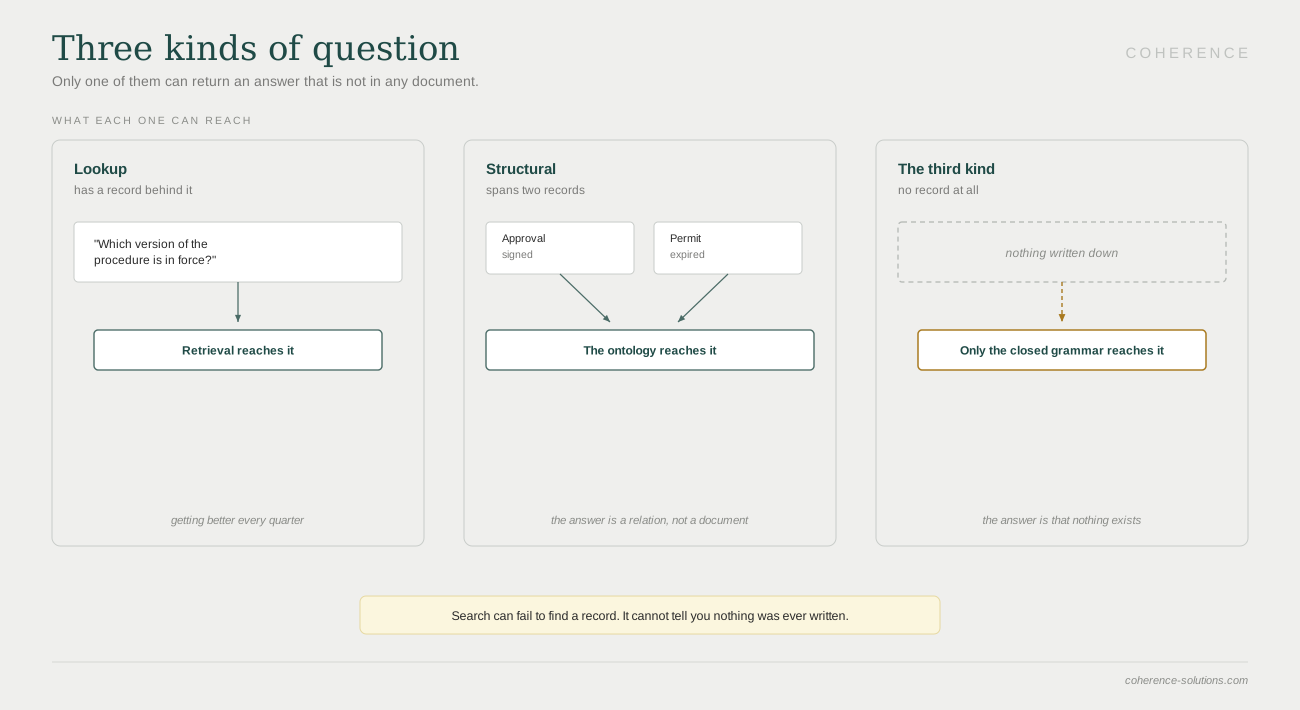
Retrieval answers questions that have a record behind them. An ontology answers questions whose answer lives in how records relate. There is a third kind, and its answer is about something that is not in your material at all.
An auditor asks whether Article 14 is covered.
Somebody searches. Three documents come back, and all three are genuinely about Article 14: the policy that restates it, the procedure that refers to it, and a slide from last year's programme. The search worked. Every result is relevant. Nobody has answered the question, because the auditor did not ask what mentions Article 14. She asked whether anything enforces it.
Those are different questions, and only one of them has a document behind it.
This piece sits alongside the series on what Coherence is and does. Part 1 covered the layer that models what is required to exist, not only what does. Part 3 covered the grammar that makes that possible, and why nobody gets to edit it. This one is about the shape of the questions that grammar exists to answer, because the shape is what decides whether any of the rest of it was worth building.
The landscape, as a ladder
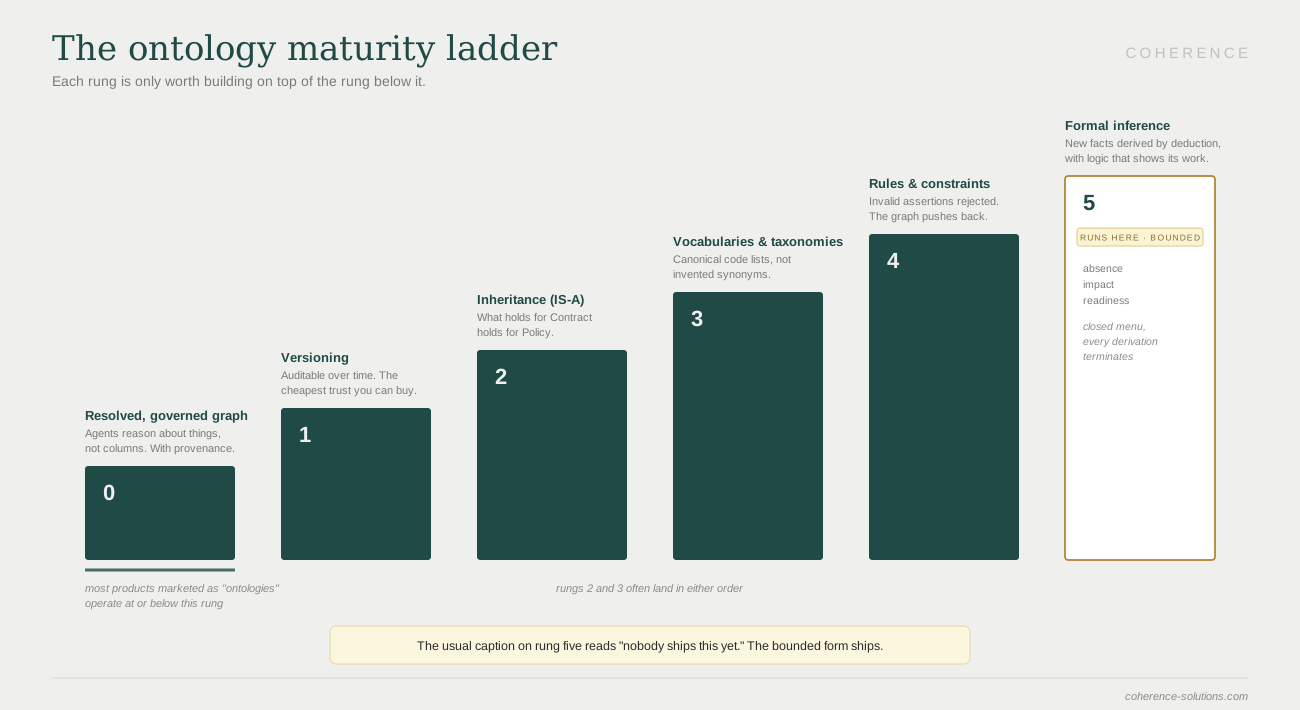
A maturity ladder for ontologies has been going around, and it is a fair map of where the field stands. A resolved, governed graph at the bottom, so agents reason about things rather than columns. Versioning above it, the cheapest trust you can buy. Then inheritance, then shared vocabularies, then rules and constraints, where the graph starts rejecting invalid assertions instead of storing them. Each rung is only worth building on top of the rung below it, and most products marketed as ontologies operate at or below the bottom one.
The top rung is formal inference: new facts derived by deduction, with logic that shows its work. The caption that travels with it says nobody ships this yet.
We read that caption narrowly. Nobody ships the open form, and given what a reasoner does to the errors underneath it, nobody should be in a hurry to. A bounded form is a different matter: a closed menu of derivations, every one terminating, every one showing its work, and no conclusion ever fed back in as a premise. The rest of this piece is the case for it. Less than the rung promises. More than the caption allows.
One more thing the ladder gets right: the order. Inference is only worth trusting while everything under it holds, rules the graph enforces, one vocabulary, propagation that behaves, versions, provenance. Skip a rung and the deduction still runs. It just proves things about a graph nobody should believe.
Most questions split cleanly in two
Lookups have a record behind them. What is this customer's exposure. When did the permit issue. Which version of the procedure is in force. Something somewhere contains the answer, and the work is finding it and being sure it is the right one. Retrieval is good at this now. It has improved every quarter for three years and it will keep improving, and any argument that depends on it staying bad is an argument with a short life.
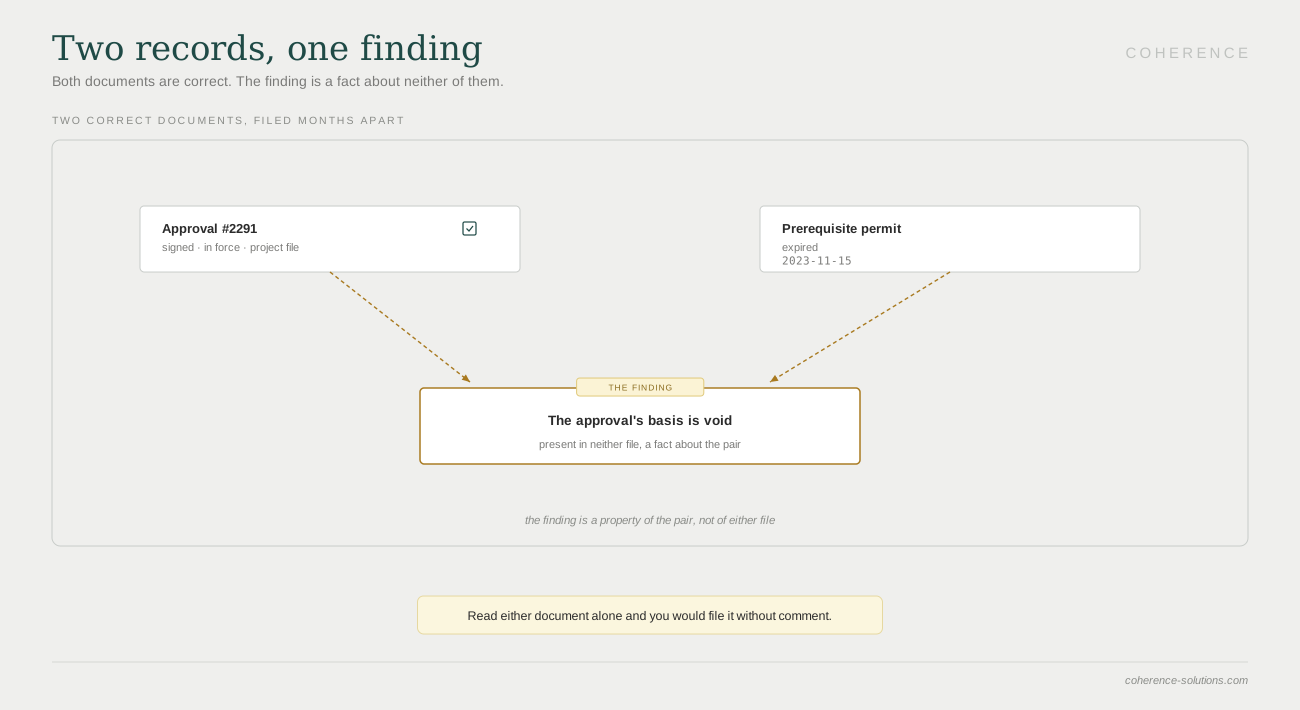
Structural questions have no such record. Their answer is a property of how records relate, and it survives in none of them on its own.
Part 4 has a worked one. In a project file, an approval sits signed and in force. Three folders away, the permit it was granted on the basis of expired months ago. Both documents are correct. Neither is unusual. Read either one and you would file it without comment. The finding, that the approval's basis is void, appears in neither, because no single document carries it. It only exists across the pair.
This part is now well understood, and the better writing about ontologies over the last year has been about exactly this. The remedy everyone converges on is the same, and we converge on it too: write down what the things are, what the connections mean, and what rules hold across them, once, somewhere a person and a machine can both read. That is the ontology, and Part 3 is the whole argument for it.
What we would add is that the split is not in two.
The third kind
The third kind has no record and no relation either. Its answer is about something that is not in your material at all.
Is anything enforcing Article 14. Which of our controls stop working after the migration. What does this capability actually run on. Which obligation has nobody accountable for it. Each of those can come back with the answer nothing, and the nothing is the finding.
Retrieval cannot reach them, and not because it is imprecise. It can only return what is there. Traversal cannot reach them either, however good the graph, because you can only walk to a node that exists. A larger context window does not help, because the control that should enforce Article 14 is not a document that failed to make the shortlist. It was never written. There is no file, no row, no paragraph, no edge. There is a requirement, and an empty place where the answer to it should be.
Search can fail to find a record. Traversal can only reach the things that exist. Neither of them can return a fact about something that was never written down.
The uncomfortable part is that these are the questions people actually care about. Nobody convenes a committee to establish which procedure is in force. They convene one because somebody suspects a hole and cannot prove where it is.
Where an absence comes from
An absence is computable for one reason, and it is the reason the grammar is fixed.
Because there is a closed set of kinds of thing and a closed set of legal connections between them, every kind knows what it needs in order to be real. An obligation needs a control. A risk needs something mitigating it. A goal needs an initiative. An initiative needs a capability, and a capability needs a system to run on. A system carrying no capability is orphaned technology, which is its own kind of problem. Seven rules run across the whole map, and each one fires when the thing that should be there isn't.
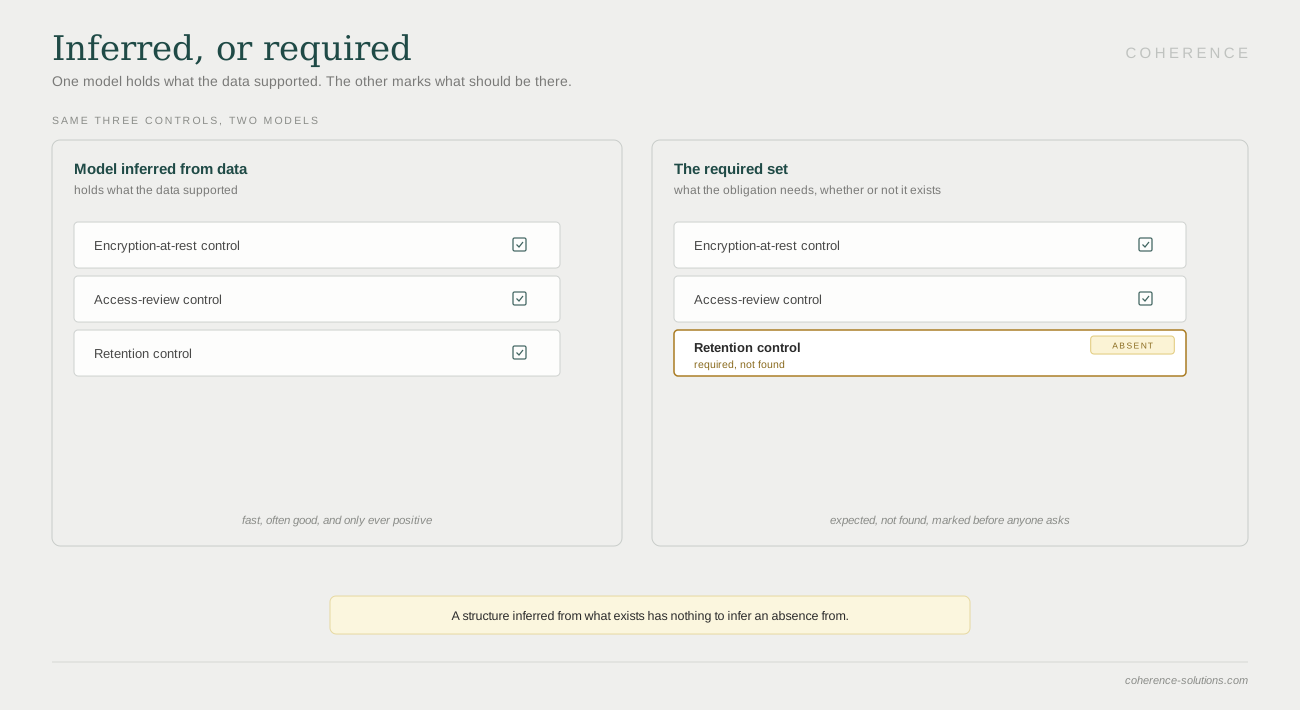
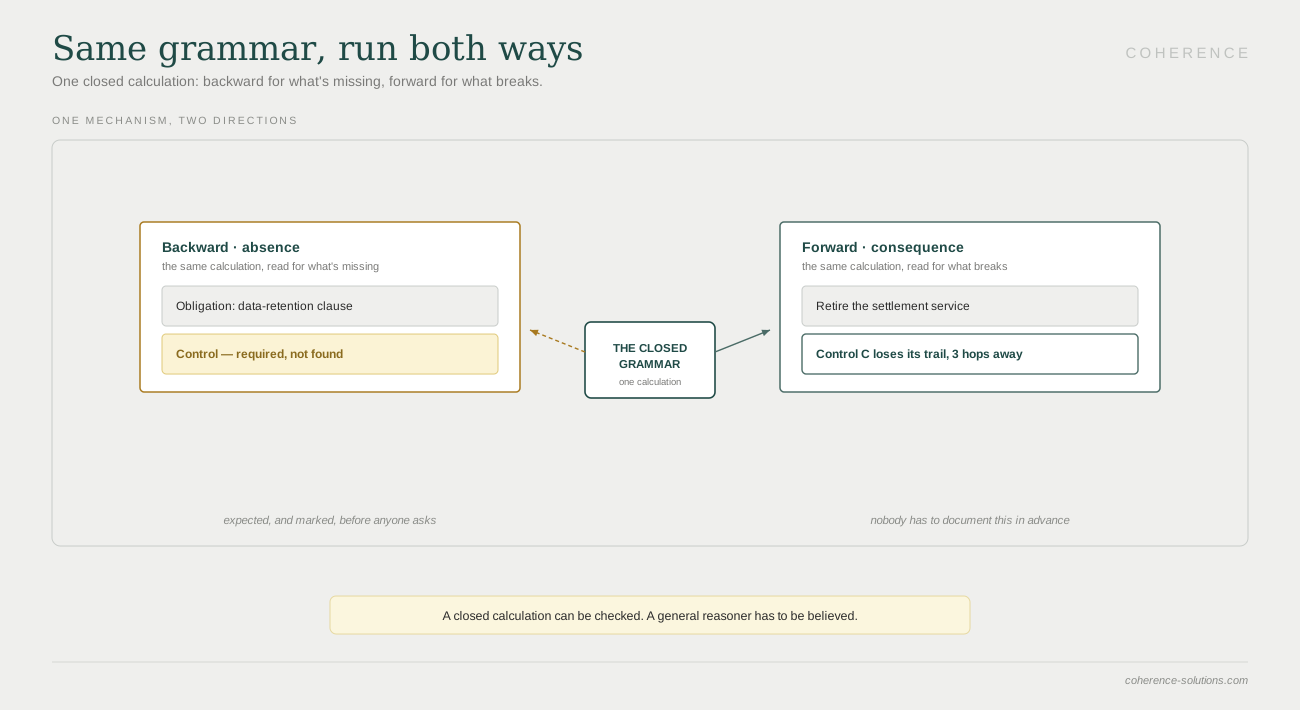
So the obligation with nothing enforcing it is not missing from the ontology. It is in the ontology, marked, with the name of what was expected sitting next to it. Nobody had to suspect it first.
Now compare that with a model derived from your data. Such a model holds what the data supported. Building one is fast, it is often a good model, and the speed is a real advantage rather than something to wave away. But what the data did not support is not marked absent in it. It is simply not in the picture, and nothing in the picture tells a control that was never required apart from a control that is required and missing.
No release closes that gap, because the gap sits in the direction the model was built. A structure inferred from what exists has nothing to infer an absence from.
A search that returns nothing and a rule that returns false look identical on a screen. Only one of them is a finding.
The same property, run forwards
Absence is one direction. The other is consequence: what breaks if this changes, what this obligation reaches, what a decommission takes down with it, which roles miss a target they are measured on.
It is the same mechanism pointed the other way. The answer is computed against the map rather than read off the material, so it does not depend on anyone having documented the consequence in advance. Nobody writes down that retiring a settlement service quietly strands a control three layers away. It falls out of the connections.
There is a discipline attached to this and it is worth stating plainly, because it is the line we do not cross. What runs is a closed menu of calculations, impact, absence and readiness, computed when you ask, each one showing the path it took to its answer. It is not a general reasoner turned loose on the graph to derive whatever it can and write the results back in. That is a real category, some serious people are working on it, and the honest objection to it is one they make themselves: a reasoner amplifies whatever is underneath it, including the errors.
A general reasoner has to be believed. A closed calculation can be checked.
What it costs to be able to say it
Three costs, and they are the ones to press us on.
The grammar has to be closed. Absence is only computable while the kinds of thing are finite and known, which means the metamodel is fixed in source code and identical in every deployment. Not editable in settings, not by request, not for a large enough contract. Part 3 makes that case at length and it remains the most argued-with decision in the platform. This is what it buys.
The domain has to be authored. An absence computed over a domain nobody has modelled is not a finding, it is unfinished work wearing a finding's clothes. The parsers are mechanical; the modelling is judgement, and it needs someone who knows the business in the room. Take the smaller domain with a real owner over the bigger one with a stand-in, every time.
And what is absent is bounded by what was read in. The ontology knows the material it was given. Material nobody supplied is a declared gap rather than an inference, and we would rather say so than let it round up. Coverage stays two numbers, confirmed and suggested, because a single blended percentage is the easiest figure in enterprise software to inflate, and because a candidate link is not the same kind of connection as a proven one.
None of that makes the third kind of question go away. It just decides whether your estate can answer it.
Back to the auditor
She asks whether Article 14 is covered.
The useful answer turns out not to be a document at all. It is a rule that came back false, naming the control that should have addressed the obligation, the capability that would have carried it, and the system it would have run on, none of which exist, which is the point. Beside it, the obligations where the same rule came back true, each one resolving to a function in a file at a revision she can open.
A tracker can tell her four things are pending. Only a model that holds what is required can tell her that one of them was never going to arrive.
The permitting material referenced here is modelled on synthetic sources: real cadastral numbers and real deadlines, no client data. Figures from our own estates are labelled as such. Effort and timing figures in this series are design targets validated per engagement, not warranties.

This site uses cookies
We use essential cookies for the site to function and analytics cookies (Google Analytics) to understand how you use it. Analytics cookies are only activated with your consent. We do not track you across other websites. Your data is stored in the EU and processed in accordance with GDPR. Read our Privacy Policy

